Minimising Exchange Latency in the Cloud
[2026-05-28 10:00:00 +1000]Trading, at a high level, is an extremely broad set of activities but ultimately boils down to moving information around. This information often has an incredibly short shelf life. For this reason, trading (in any form) benefits from speed. When we are trading with computers, our speed is overwhelmingly dominated by communicating with our counterparties via an exchange. As such, we want to get our computer as close as we reasonably can to the exchange's computer. Ideally, this would be relatively straightforward, but our world is far from ideal. In reality, there are complexities like CDNs, load balancers, the architecture of the exchange's infrastructure, which transport protocol we're using, and many more.
In this tutorial, we'll progress through a few different approaches to measuring the network latency that we actually experience when interacting with an exchange, increasing the complexity of each approach only when strictly necessary to improve the accuracy of our measurements. We'll automate the process using a tool that I've written, ringer.
Homework
Firstly, some exchanges explicitly state where their computers are located. This is certainly not the typical posture, but there are some notable examples of exchanges being very transparent about this. Bybit, for instance, claims to be hosted in ap-southeast-1 (specifically the apse1-az2 and apse1-az3 Availability Zones) as part of their official documentation.
If the exchange doesn't straight up tell us where they are, we can still find out through plenty of alternative channels. For crypto specifically, this will often be on Discord servers or in Telegram channels (official or otherwise). Good old-fashioned research on the web still pays dividends even in 2026: consider this Reuters coverage of a Binance outage that they directly attribute to downtime for AWS Tokyo (i.e., ap-northeast-1). Following this lead, I was able to find this article narrowing it down even further to a specific AZ: apne1-az4.
Now, Binance's cloud hosting location is perhaps the worst-kept secret in all of crypto. Regardless, the point is that due diligence can often allow us to corroborate the results of our own latency work or even bypass it altogether.
Pinging
Naively, our initial strategy might be to simply ping the exchange's API endpoint. Something like this,
FIND-MINIMUM-LATENCY(target, available_regions)
    min_latency := INFINITY
    best_region := NULL

    for region in available_region
        START-INSTANCE(region)
        curr_latency := PING(target)

        if curr_latency <= min_latency
            min_latency := curr_latency
            best_region := region

    return (best_region, min_latency)
The problem with this solution is that ping(8) simply sends an ICMP echo request (i.e., control message type 0x81) to the remote host. This is fine for getting the latency to a "normal" computer but will not work for our task. There are two reasons for this: exchanges treat ICMP traffic differently to TCP traffic and there are network intermediaries between us and the exchange (namely CDN edge gateways and load balancers). For the latter issue, when we ping the exchange our ICMP packets will first hit the CDN's edge node; the response that we receive is from the edge node itself rather than the CDN application layer — and this is assuming that the CDN does not just immediately drop our request.
As a concrete example, let's consider what pinging Bybit's API looks like from my home network.
$ ping -c 10 api.bybit.com
PING d3d4ij29qlbhtu.cloudfront.net (18.155.216.88) 56(84) bytes of data.
64 bytes from server-18-155-216-88.bne50.r.cloudfront.net (18.155.216.88): icmp_seq=1 ttl=248 time=2.81 ms
64 bytes from server-18-155-216-88.bne50.r.cloudfront.net (18.155.216.88): icmp_seq=2 ttl=248 time=3.89 ms
64 bytes from server-18-155-216-88.bne50.r.cloudfront.net (18.155.216.88): icmp_seq=3 ttl=248 time=5.44 ms
64 bytes from server-18-155-216-88.bne50.r.cloudfront.net (18.155.216.88): icmp_seq=4 ttl=248 time=4.54 ms
64 bytes from server-18-155-216-88.bne50.r.cloudfront.net (18.155.216.88): icmp_seq=5 ttl=248 time=5.75 ms
64 bytes from server-18-155-216-88.bne50.r.cloudfront.net (18.155.216.88): icmp_seq=6 ttl=248 time=4.51 ms
64 bytes from server-18-155-216-88.bne50.r.cloudfront.net (18.155.216.88): icmp_seq=7 ttl=248 time=3.42 ms
64 bytes from server-18-155-216-88.bne50.r.cloudfront.net (18.155.216.88): icmp_seq=8 ttl=248 time=4.18 ms
64 bytes from server-18-155-216-88.bne50.r.cloudfront.net (18.155.216.88): icmp_seq=9 ttl=248 time=3.77 ms
64 bytes from server-18-155-216-88.bne50.r.cloudfront.net (18.155.216.88): icmp_seq=10 ttl=248 time=3.39 ms

--- d3d4ij29qlbhtu.cloudfront.net ping statistics ---
10 packets transmitted, 10 received, 0% packet loss, time 9017ms
rtt min/avg/max/mdev = 2.807/4.170/5.752/0.872 ms
There is no way that I actually live anywhere near 5ms away from Bybit's API endpoint. These response times are from my closest2 CloudFront edge node. It's worth noting that at no point in the above output from ping(8) did the hostname ever resolve to anything Bybit-specific, which is extremely telling.
Shaking Hands
A better method is to connect to the exchange server. The minimal way to do this is to time how long it takes to complete a TCP handshake. The algorithm is essentially the same as the one above: for each AWS3 cloud region, perform a full TCP handshake and record how long it takes for this handshake to complete. Essentially, execute this program from each AWS region:
import socket, time, json

host = "api.bybit.com"
port = 443
samples = 10

rtts = []
for _ in range(samples):
    t0 = time.perf_counter()
    try:
        s = socket.create_connection((host, port), timeout=2)
        s.close()
        rtts.append((time.perf_counter() - t0) * 1000)
        print(rtts[-1])
    except OSError:
        pass
Now, actually doing the deployment programmatically is somewhat more involved. What we can do is have our payload program write some JSON-formatted results data to an S3 bucket and then associate each result set with the region that it's from — which is what ringer does. Using ringer requires some prerequisite setup. This is mostly having an AWS account that's either funded or has free-tier credits and then configuring IAM roles and permissions. Assuming that you've met these necessary requirements, then it's rather straightforward to perform this TCP benchmark:
$ uv run ringer.py \
    --target api.bybit.com \
    --port 443 \
    --bucket latency-sweep-results
Probing 18 regions → api.bybit.com:443 (tcp)
All instances launched — waiting for results...

[ap-southeast-2] p50=1.14ms
[ap-southeast-4] p50=0.89ms
[ap-southeast-1] p50=1.21ms
[ap-northeast-1] p50=2.91ms
[ca-central-1] p50=1.50ms
[eu-west-2] p50=1.04ms
[us-west-1] p50=0.75ms
[sa-east-1] p50=1.08ms
[ap-northeast-2] p50=0.59ms
[us-east-2] p50=1.46ms
[eu-west-3] p50=1.07ms
[ap-northeast-3] p50=1.03ms
[ap-south-1] p50=1.17ms
[eu-north-1] p50=3.39ms
[eu-west-1] p50=0.91ms
[us-west-2] p50=5.58ms
[eu-central-1] p50=1.18ms

All instances terminated — no more results coming.

Warning: 1 region(s) never reported results

Region                         min      p50      p99  samples
-----------------------------------------------------------------
ap-northeast-2               0.44ms    0.59ms    6.85ms  100
us-west-1                    0.56ms    0.75ms   12.90ms  100
ap-southeast-4               0.74ms    0.89ms   28.58ms  100
eu-west-1                    0.80ms    0.91ms 2005.28ms  100
ap-northeast-3               0.82ms    1.03ms   23.38ms  100
eu-west-2                    0.75ms    1.04ms    5.59ms  100
eu-west-3                    0.97ms    1.07ms    4.50ms  100
sa-east-1                    0.89ms    1.08ms    5.59ms  100
ap-southeast-2               0.91ms    1.14ms    9.47ms  100
ap-south-1                   0.92ms    1.17ms    4.54ms  100
eu-central-1                 0.94ms    1.18ms    6.26ms  100
ap-southeast-1               0.83ms    1.21ms    6.83ms  100
us-east-2                    1.13ms    1.46ms   10.30ms  100
ca-central-1                 0.82ms    1.50ms    6.31ms  100
ap-northeast-1               2.11ms    2.91ms 1050.68ms  100
eu-north-1                   3.09ms    3.39ms    8.89ms  100
us-west-2                    5.20ms    5.58ms 2055.84ms  100

Best region: ap-northeast-2 (p50=0.59ms)
This approach should be surprising to us: recall from our research above that Bybit claims to be hosted in ap-southeast-1 yet ringer reports that ap-northeast-2 is the optimal region. The problem with this approach is similar to the problem with pinging: CDNs. When we complete this TCP handshake, we're actually establishing a connection to the edge node. This edge node does a few things (like TLS termination) and then forwards (certain) traffic to the backend application layer.
Actual Connection
A reliable way to ensure that we're actually talking to the real exchange is to pull live order book data from it. After all, no CDN can cache nor predict prices4. Fortunately, ringer also supports this approach:
$ uv run --with boto3 python3 ringer.py \
    --target stream.bybit.com \
    --port 443 \
    --bucket latency-sweep-results \
    --ws \
    --ws-path /v5/public/spot \
    --subscribe '{"op":"subscribe","args":["orderbook.1.BTCUSDT"]}'
Probing 18 regions → stream.bybit.com:443 (websocket)

All instances launched — waiting for results...

[ap-southeast-1] p50=23.64ms  msg_p50=2.09ms  msg_p99=6.95ms
[ap-south-1] p50=201.48ms  msg_p50=61.81ms  msg_p99=69.44ms
[ap-northeast-1] p50=222.09ms  msg_p50=69.06ms  msg_p99=96.48ms
[ap-southeast-4] p50=322.55ms  msg_p50=102.68ms  msg_p99=108.01ms
[ap-northeast-2] p50=220.59ms  msg_p50=68.12ms  msg_p99=90.87ms
[ap-northeast-3] p50=246.55ms  msg_p50=77.23ms  msg_p99=115.81ms
[ap-southeast-2] p50=293.87ms  msg_p50=92.77ms  msg_p99=102.11ms
[eu-central-1] p50=486.98ms  msg_p50=157.06ms  msg_p99=171.56ms
[eu-west-3] p50=484.66ms  msg_p50=156.81ms  msg_p99=179.80ms
[eu-west-2] p50=507.50ms  msg_p50=164.26ms  msg_p99=175.16ms
[eu-west-1] p50=533.41ms  msg_p50=172.69ms  msg_p99=210.73ms
[us-west-2] p50=501.22ms  msg_p50=159.68ms  msg_p99=170.28ms
[eu-north-1] p50=546.71ms  msg_p50=176.40ms  msg_p99=190.13ms
[us-west-1] p50=521.25ms  msg_p50=168.92ms  msg_p99=189.65ms
[us-east-2] p50=640.52ms  msg_p50=207.31ms  msg_p99=219.48ms
[ca-central-1] p50=693.62ms  msg_p50=226.01ms  msg_p99=244.68ms
[sa-east-1] p50=997.22ms  msg_p50=326.46ms  msg_p99=338.76ms

All instances terminated — no more results coming.

Region                      hs_min   hs_p50   hs_p99  msg_p50  msg_p99  samples
-------------------------------------------------------------------------------------
ap-southeast-1              18.72ms   23.64ms   41.58ms    2.09ms    6.95ms  100
ap-south-1                 194.25ms  201.48ms  265.11ms   61.81ms   69.44ms  100
ap-northeast-2             215.11ms  220.59ms  257.95ms   68.12ms   90.87ms  100
ap-northeast-1             217.05ms  222.09ms  252.72ms   69.06ms   96.48ms  100
ap-northeast-3             239.85ms  246.55ms  433.92ms   77.23ms  115.81ms  100
ap-southeast-2             289.06ms  293.87ms  340.18ms   92.77ms  102.11ms  100
ap-southeast-4             316.13ms  322.55ms  407.47ms  102.68ms  108.01ms  100
eu-west-3                  451.92ms  484.66ms  552.24ms  156.81ms  179.80ms  100
eu-central-1               484.04ms  486.98ms  602.17ms  157.06ms  171.56ms  100
us-west-2                  490.79ms  501.22ms  533.51ms  159.68ms  170.28ms  100
eu-west-2                  476.42ms  507.50ms  539.66ms  164.26ms  175.16ms  100
us-west-1                  512.56ms  521.25ms  544.22ms  168.92ms  189.65ms  100
eu-west-1                  499.69ms  533.41ms  565.09ms  172.69ms  210.73ms  100
eu-north-1                 542.41ms  546.71ms  587.43ms  176.40ms  190.13ms  100
us-east-2                  604.84ms  640.52ms  697.95ms  207.31ms  219.48ms  100
ca-central-1               664.43ms  693.62ms  764.59ms  226.01ms  244.68ms  100
sa-east-1                  967.92ms  997.22ms 1031.48ms  326.46ms  338.76ms  100

Best region: ap-southeast-1 (first_msg_p50=2.09ms)
This result, ap-southeast-1, is consistent with what we discovered above during our research phase; our 99th percentile time-to-first-message is 6.95ms, which agrees with our intuition.
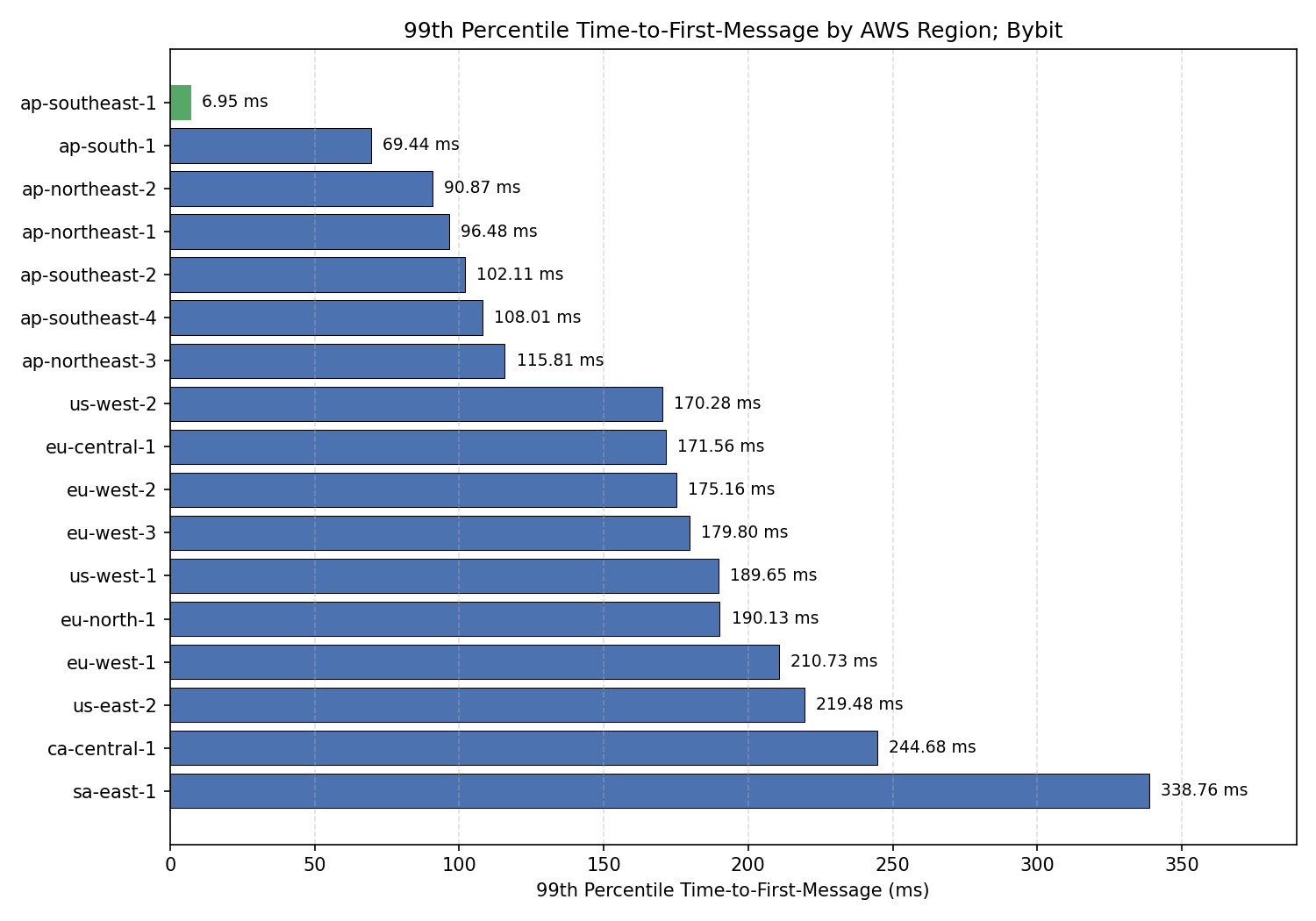
msg_p99) for BybitConclusion
This search task is fairly easy to automate and could drastically reduce your latency to the exchange that you're trading on. To drive the point home, if we were trading on Bybit and had decided to host in us-east-2 (Ohio), then we'd be over 31 times slower5 than our competition in ap-southeast-1 (Singapore) — and this does not even take into account other speed advantages that they may have.
It's worth noting that the metric we've used throughout, time-to-first-message, isn't actually that useful for real production trading infrastructure; however, it suffices for determining where to put our computer. In a real setting, we likely care much more about our tick-to-trade latency. Additionally, there is a lot more work that goes into latency optimisation and what we've covered here is simply the first6 step in a long process.
Bibliography
[1] J. Postel, "Internet Control Message Protocol," RFC 792, Sep. 1981. [Online]. Available: https://datatracker.ietf.org/doc/html/rfc792. [Accessed: May 27, 2026].
[2] apalrd, "Starting my own Content Delivery Network," YouTube, May 15, 2026. [Online]. Available: https://www.youtube.com/watch?v=LCJIQufZeeg. [Accessed: May 27, 2026].
[3] Bybit, "Where are Bybit's Servers Located?" in Bybit API Documentation, Bybit. [Online]. Available: https://bybit-exchange.github.io/docs/faq#where-are-bybits-servers-located. [Accessed: May 27, 2026].
[4] Amazon Web Services, "Regions and Zones," in Amazon EC2 User Guide. [Online]. Available: https://docs.aws.amazon.com/AWSEC2/latest/UserGuide/using-regions-availability-zones.html#concepts-availability-zones. [Accessed: May 27, 2026].
[5] Reuters, "Binance Services Start to Recover After Network Interruption," Reuters, Apr. 15, 2025. [Online]. Available: https://www.reuters.com/technology/binance-services-start-recover-after-network-interruption-2025-04-15. [Accessed: May 27, 2026].
[6] Data Center Dynamics, "Network Issue at AWS Data Center Brings Down Crypto Exchanges," Data Center Dynamics, Feb. 11, 2026. [Online]. Available: https://www.datacenterdynamics.com/en/news/network-issue-at-aws-data-center-brings-down-crypto-exchanges. [Accessed: May 27, 2026].
[7] J. Albers, M. Cucuringu, S. Howison, and A. Y. Shestopaloff, "The Good, the Bad, and Latency: Exploratory Trading on Bybit and Binance," SSRN Working Paper 4677989, Nov. 2024. [Online]. Available: https://papers.ssrn.com/sol3/papers.cfm?abstract_id=4677989. [Accessed: May 27, 2026].
[8] Databento, "What is Tick-to-Trade Latency?" in Databento Microstructure Guide, Databento, Inc. [Online]. Available: https://databento.com/microstructure/tick-to-trade. [Accessed: May 27, 2026].
The Internet Control Message Protocol (ICMP) is specified in RFC 792 and is one of the oldest Internet protocols still in widespread use today.
Technically the "cheapest route", but this is usually the same as physical proximity these days. The actual specifics of this involve traversing the BGP rabbit hole.
You needn't choose AWS as the cloud provider and should, in fact, choose the provider which the target server is hosted with. With this being said, virtually every serious exchange is going to be hosted on AWS. I've chosen AWS for this article because it is ubiquitous, has the largest set of available regions, and exposes programmatic access to enable us to automate our search.
If you're aware of one that does, then I'd like to invest.
I'm comparing the 99th percentile WebSocket handshake times.
And likely the step with the largest improvement!